
Choosing bathroom floor tiles in Massachusetts isn’t the same as choosing them anywhere else. New England homes deal with cold winters, high humidity, radiant heat systems, and a housing stock that ranges from 1890s Victorians to brand-new construction. The tile that looks stunning in a California showroom may buckle, stain, or just feel wrong once it’s installed in a Boston-area bathroom.
This guide covers the five best bathroom floor tiles for New England homes – chosen for durability in cold climates, compatibility with how Massachusetts homes are actually built, and designs that hold up for decades without looking dated.
1. Porcelain Tile: The Best All-Around Bathroom Floor Tile for Massachusetts Homes
If there’s one tile that earns a near-universal recommendation for Massachusetts bathrooms, it’s porcelain.
Porcelain is fired at higher temperatures than ceramic, making it denser, harder, and almost impervious to water absorption – a critical advantage in bathrooms that face New England’s freeze-thaw temperature swings. It won’t crack from radiant heat systems, resists mold and mildew in high-humidity bathrooms, and holds up to decades of daily use without significant wear.
Best formats for New England bathrooms:
- Large-format (24″x24″ or larger) for master bathrooms and open wet rooms
- Rectified edges for thin, clean grout lines that are easier to maintain
- Matte or textured finish for slip resistance on wet floors
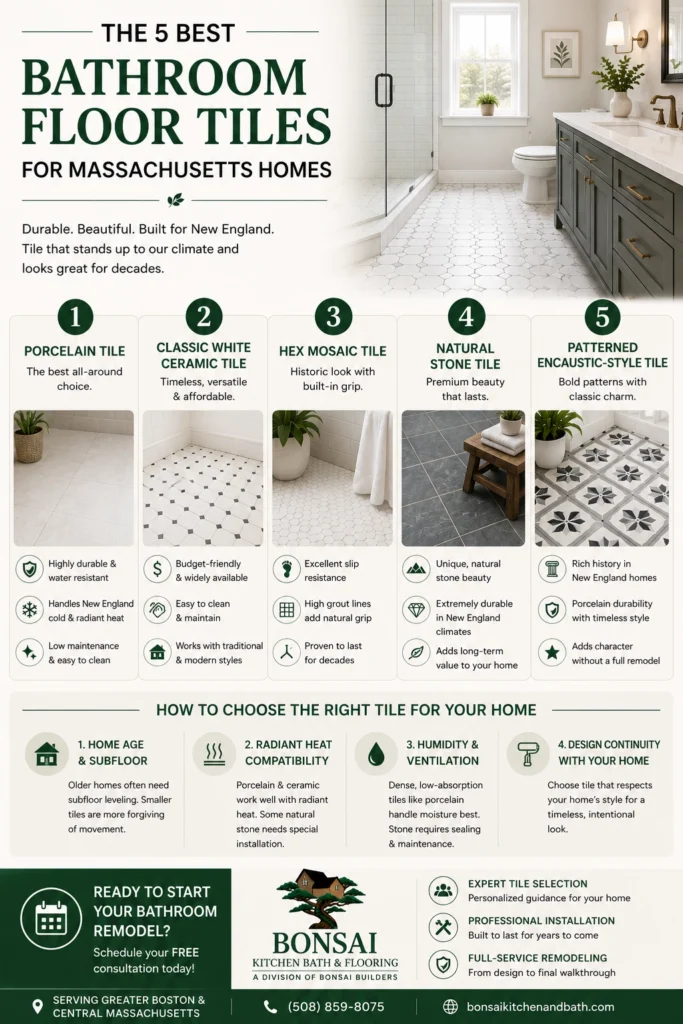
2. Classic White Ceramic Tile: Timeless Bathroom Flooring for Boston-Area Homes
Ceramic tile remains one of the most popular bathroom flooring choices across the Greater Boston area – and for good reason. It’s more affordable than porcelain, widely available locally, and comes in the classic white finishes that work naturally with New England’s colonial, cape, and craftsman home styles.
For bathroom floors specifically, choose matte or honed ceramic over glossy. Glossy ceramic shows every water spot and becomes slippery when wet – two problems that compound quickly in a bathroom that sees heavy daily use.
Why it works in New England homes:
- Compatible with most existing subfloor types common in older Massachusetts homes
- Easy to match and replace individual tiles decades later
- Works with both traditional and modern bathroom remodel styles
3. Hex Mosaic Tile: A Historic Choice for New England Bathroom Renovations
Penny tile and hex mosaics have been installed in New England bathrooms since the early 1900s. Walk through any older neighborhood in Worcester, Providence, or Cambridge and you’ll find original hex tile floors still intact after a century of use. That’s not a coincidence – it’s a testament to how well this format holds up.
Small-format mosaic tile also has a practical advantage for Massachusetts bathrooms: the high ratio of grout lines to tile surface creates natural grip, making it one of the safer choices for wet floors – important for families and for homes with older residents.
Design tip for New England homes: White hex on a dark grout reads as period-appropriate in Victorian and craftsman homes. Black-and-white hex works in colonial and federal-style bathrooms. Both are available from most Massachusetts tile suppliers.
4. Natural Stone Tile: Premium Bathroom Flooring for High-End Massachusetts Remodels
Marble, slate, and travertine have been used in bathrooms for centuries. For Massachusetts homeowners investing in a high-end bathroom renovation, natural stone delivers a look and feel that no manufactured tile has fully replicated – and it genuinely improves with age rather than wearing out.
Slate in particular is worth highlighting for New England homes. It’s quarried throughout the Northeast, handles temperature changes exceptionally well, and its naturally textured surface provides built-in slip resistance. Marble works beautifully in master bathrooms where it gets regular maintenance; travertine suits a warmer, rustic aesthetic common in Western Massachusetts and rural New England homes.
What Massachusetts homeowners should know about stone floors:
- Natural stone requires annual sealing to resist moisture
- Avoid acidic cleaners – common in many households but damaging to stone
- Budget for professional installation; uneven subfloors (common in older MA homes) need to be leveled before stone goes down
5. Patterned Encaustic-Style Tile: Bold Bathroom Flooring That Fits New England Character
Encaustic and geometric patterned tiles have a long history in New England architecture – Victorian-era homes across Massachusetts were built with decorative tile floors that still define those spaces today. The modern version, porcelain-bodied encaustic-look tile, gives you all the visual richness of traditional cement tile with far better water resistance and durability.
The key to making patterned tile timeless rather than trendy is sticking to classic two-color geometric combinations: black and white, navy and cream, or terracotta and white. These colorways have appeared in New England homes for over 150 years and don’t belong to any single design moment.
Where it works best in Massachusetts homes:
- Powder rooms and half baths where the floor is a focal point
- En-suite bathrooms in Victorian or craftsman homes where you want to honor the home’s original character
- Bathroom remodels where you want personality without a full gut renovation
How to Choose the Right Bathroom Floor Tile for Your Massachusetts Home
The right tile depends on four factors specific to New England homes:
1. Your home’s age and subfloor condition. Older Massachusetts homes – pre-1950s especially – often have subfloors that need leveling before bathroom tile installation. Large-format tile and natural stone are less forgiving of subfloor movement than smaller mosaic formats.
2. Radiant heat compatibility. If you’re adding underfloor heating (a popular upgrade in cold New England winters), confirm your tile choice is rated for radiant heat systems. Porcelain and ceramic handle this well; some natural stones require more careful installation.
3. Humidity and ventilation. Bathrooms with poor ventilation trap moisture. Dense, low-absorption tiles like porcelain are more forgiving; natural stone requires proper sealing and consistent maintenance.
4. Design continuity with your home. Massachusetts homes have strong architectural identities. Tile that respects the home’s period – hex in a 1920s colonial, large-format porcelain in a modern addition – will look more intentional than tile chosen purely from trend.
Get Expert Bathroom Tile Installation in Massachusetts
Choosing the right bathroom floor tile is only half the equation – installation quality determines how long it actually lasts. Our team works with Massachusetts homeowners across Greater Boston, Central MA, and surrounding areas to handle everything from tile selection through full bathroom renovation, backed by the complete build capabilities of Bonsai Builders.
Ready to start your bathroom remodel? Contact Bonsai Kitchen Bath & Flooring for a FREE consultation.